Systems Thinking for Technology Leaders
Modern technology organizations rarely behave the way we expect them to.
A new feature introduces unexpected performance issues. A change in infrastructure slows product velocity. A decision intended to simplify a system quietly creates new forms of complexity elsewhere.
These outcomes are not unusual. They are symptoms of something deeper.
Technology organizations are not simply collections of software systems and engineering teams. They are complex systems, where architecture, product design, human workflows, and decision-making processes interact continuously.
Understanding these interactions requires a different perspective.
It requires systems thinking.
Technology Organizations as Systems
Traditional engineering culture often encourages a reductionist approach to problems. Break the system into components, solve each part independently, and the whole should function as expected.
In modern technology environments, this rarely works.
Cloud infrastructure, distributed services, machine learning models, and data pipelines interact across layers of abstraction. Product decisions influence technical architecture, and technical constraints shape product direction.
The result is an ecosystem rather than a machine.
In my experience building technology systems, including work at Pollen.tech, it became clear that product features, data flows, and infrastructure decisions rarely exist in isolation. They form a network of interactions where changes in one part of the system affect the behavior of the whole.
Technology leadership in such environments becomes less about managing components and more about understanding relationships.
Seeing the System
Systems thinking begins with a simple shift in perspective: instead of focusing only on parts, it focuses on patterns of interaction.
In technology organizations, these patterns often appear as feedback loops.
Engineering teams move faster when infrastructure is stable. Stable infrastructure often emerges from architectural decisions made months earlier. Those architectural decisions are influenced by product timelines and business priorities.
Over time, these interactions create reinforcing cycles that shape how an organization builds technology.
A technology leader who only sees individual decisions may miss the pattern.
A leader who sees the system can begin to influence how those patterns evolve.
The CTO as a Systems Designer
This perspective changes the nature of technology leadership.
Instead of focusing only on technical execution, the CTO begins to shape the conditions under which systems evolve.
This might involve:
designing architectures that allow teams to move independently
creating decision frameworks that balance speed with long-term resilience
structuring engineering organizations to reduce unnecessary coupling
integrating new technologies such as AI without destabilizing existing workflows
The CTO becomes less of a manager of technology and more of a designer of systems.
In practice, this means asking different questions.
Not just:
Is this the right technical solution?
But also:
How will this decision shape the system over time?
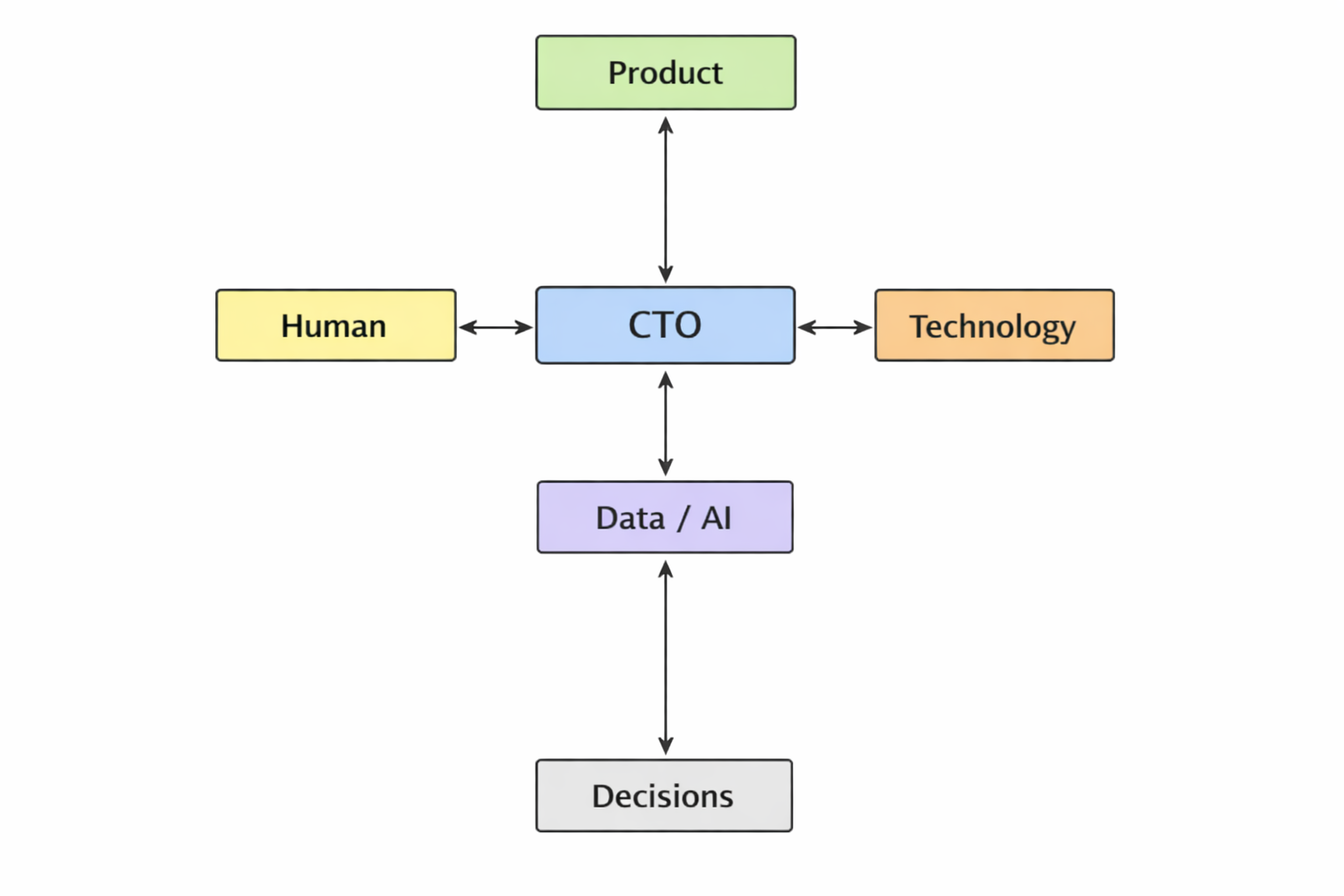
CTO Role FlowChart in AI Era
Complexity and Adaptation
As technology systems grow more interconnected, predicting their behavior becomes increasingly difficult.
Small decisions can produce large effects. Solutions that appear simple at first may create new layers of complexity later.
In such environments, the goal of technology leadership cannot be perfect control.
Instead, the goal becomes adaptation.
Systems thinking helps leaders design organizations that can learn and evolve as technology landscapes change. It encourages architectures that support experimentation and teams that can respond quickly when conditions shift.
This perspective is becoming even more important as AI becomes integrated into engineering workflows and product capabilities.
AI systems introduce new forms of complexity — not only technically, but organizationally. They change how teams work, how decisions are made, and how products evolve.
Understanding these dynamics requires leaders who can think beyond individual technologies and see the system as a whole.
Systems Thinking and the Cognitive CTO
The idea of the Cognitive CTO builds directly on this perspective.
If technology organizations are complex systems, then the role of the CTO cannot be limited to managing infrastructure or engineering teams.
The CTO must also understand the patterns through which technology systems and organizations evolve.
This means developing the ability to:
recognize feedback loops
anticipate second-order effects
design architectures that support learning and adaptation
align product, technology, and organizational systems
Systems thinking becomes one of the foundational capabilities of modern technology leadership.
Looking Ahead
As technology systems grow more complex and AI becomes embedded across organizations, the need for systems thinking will only increase.
The challenge is no longer simply building technology.
It is understanding how technology systems interact with human organizations — and how those interactions shape the evolution of both.
In the next essay, we will explore another dimension of this shift: how CTOs increasingly act as decision architects, designing the frameworks through which technology organizations make critical choices.
*This essay is part of The Cognitive CTO series exploring systems thinking and technology leadership in an AI-native era.
